
Writer's Unite: Introducing, Trenton Lee Stewart!


For today’s Writers Unite Q&A, I’d like to introduce my friend Trenton Lee Stewart, who is a
New York Times bestselling author, E. B. White Read Aloud Award winner, and New York Times
crossword puzzle contributor extraordinaire. Stewart, who has published four books and one prequel for The Mysterious Benedict Society (as well as The Secret Keepers for young readers and Flood Summer for adults), is a mastermind at weaving clever puzzles, twists and turns, and relatable characters into thrilling plotlines.
Ladies and gentlemen, please welcome Trenton Lee Stewart!
Trenton: Hi, everyone! And thanks for inviting me to this conversation, Carley!
Carley: I need to offer some background about why The Mysterious Benedict Society, which will be the focus of this interview, is such a cherished series to me: The MBS (Mysterious

Benedict Society) was one of the first books I read where grown-ups put copious trust in
children's’ abilities in very DANGEROUS situations. Other “adventure” books that I read came from Howard Pyle or Jules Verne, where it was harder to insert myself (as a small person). Oftentimes children were used as a device to get in the way and make things more difficult for the adults (like Tim and Lex in Jurassic Park) and it was thrilling to have stories where not only are the kids a part of the team for a high-stakes adventure, they’re invaluable and respected by adults (and even Mr. Curtain eventually sees them as a threat to his nefarious plans). It was finally a modern story to add to The Chronicles of Narnia and A Wrinkle in Time. Needless to say, I thank you for providing that!
Trenton: Thanks so much for the kind words! That means a lot to me.
I have a few questions for myself and my readers regarding the outlining process for your books:
Carley: What was the Genesis of your first MBS story?
Trenton: I had an idea one day about a child taking a seemingly impossible test, only to realize that there’s a secret to the test – and the child is clever enough to figure out the secret and thus pass the test. Immediately after that, it occurred to me that another child might actually know the answers to
the seemingly impossible questions. So, two kids with two different kinds of gifts. It took me
quite a while after that to realize that this was the genesis of a new book, one in which gifted kids
are recruited to go on a mission that only children could accomplish. But this clever child and
mysterious test were the first turn of the wheel.
Carley: When C. S. Lewis wrote The Lion, the Witch and the Wardrobe, it’s been said that it all started with an image in his mind of a faun carrying an umbrella in the snow. Did that kind of thing happen for you?
Trenton: Yes! I was imagining a kid taking a test, so I did picture a child at a desk with a pencil and paper. I think we can all agree that this is much less appealing an image than that of a faun carrying an umbrella in the snow. In fact, it’s a fairly miserable thing to imagine. But somehow I got away
with it.

Carley: I personally think that sounds like an intriguing beginning! How do you tackle the start of a new writing project?
Trenton: Usually what happens is I have an idea about a scene, or a character, or a predicament of some kind, and I start making notes. Pages and pages of notes, usually –
and for me this is a really fun part of the process, because I don’t have to make anything perfect, don’t have to write good sentences or figure out a good structure for the story, I just find myself asking question after question and coming up with possible answers.
How did this person end up in this situation? What’s going to happen next? How will they solve this problem? And so on. Eventually a story begins to emerge.

Carley: The above question might answer this already, but: where do you start when you begin the actual writing of a story? Do you go from beginning to end, or do some random scenes in the
middle, or something else?
Trenton: Usually from my pages of notes I create an outline. It’s subject to change depending on what I discover while writing the story, but if it looks like a reasonable approach to telling the tale, I get
started – always at chapter one. (But both my notes and my outlines contain scenes that will
appear throughout the story. So that part isn’t strictly sequential.)
Carley: So, once your outline is ready to go, what’s the hardest part of writing a story for you? The beginning, middle or end?
Trenton: The middle part of a story is pretty hard on many writers. That’s true for me as well. Maintaining momentum, looking both backward and forward – it can be tricky to pull off.
Carley: With so many clever clues to plant and overall mysteries to unravel, I’m assuming you had to do at least a little outlining for the MBS. What does that process look like for you?
Trenton: Yes, definitely, the MBS books require some careful planning. My outlines tend to get messy – I’ll be trying to keep to a rigid format, but dialogue and mini-scenes inevitably creep in.
Almost always the outlines have to change in some way, too, because things occur to me while writing the story that don’t occur to me while planning it. (This will be true for most writers, by the way. We use different parts of our brains for these different tasks.)
Ultimately it’s a balancing act between trying to relate the story in a way that makes the most sense and being open to new ideas that pop up unexpectedly.
Carley: Did it ever become difficult to come up with clever riddles and puzzles as the stories went on?
Trenton: Absolutely. At the outset of MBS, I already had a head full of riddles and puzzles and puzzle-
like situations that had accumulated over years of daydreaming. But eventually those were all
used up, and I had to think seriously about how to come up with such things on purpose. From
then on it got harder, not least because I wasn’t just trying to offer the reader riddles and puzzles, I was trying to create riddles and puzzles that would showcase the talents of my characters while
at the same time developing their personalities and their relationships. So, multiple challenges.
But fun ones!
Carley: I'm glad they were as fun to formulate as they are to read! When you started writing the MBS, did you know where the story was going to go, plot-wise? Was there anything that happened in the story that surprised you?
Trenton: Lots of little things surprise me all the time when writing a story. Every now and then a big thing does. That’s part of the pleasure of writing – being surprised by something you foolishly
believed you were in control of. The nature of MBS – one clue leading to another, which leads to
another, etc. – meant that I had to have a good sense of where the story was leading from the
outset.
Carley: Has your method of outlining a story changed at all throughout the course of writing the series?
Trenton: Not really, at least not for these particular books. They require a certain kind of planning, even though, as I’ve said, the planning usually goes sideways at some point.
Carley: Okay, in each of the MBS stories, the four children continue to grow and change (for example, Reynie *sorry, I do pronounce it RAY-nie like many readers mistakenly do* has a new personal, internal struggle in each book to work through). Did you have any long-term plans for the characters, or did it all sort of unfold as you went along? For example, did you always know what Constance was capable of?
Trenton: When I started writing MBS, I had plans only for a single book. I wanted all the characters to
experience their own arc of growth and change and discovery, which is something I want out of

any book. When it became clear I was going to write a whole series, I had to start thinking
longer-term. At that point Constance became such an appealing and exciting character for me.
I’d always loved her, of course, as I did all the MBS kids. Though I’d originally envisioned her
as the exhausting, annoying teammate that everybody has to deal with at some point in their lives, I’d also wanted to give her good reasons for being who she was, and those reasons opened up a whole world of possibilities once I realized that the story would continue, that the kids would get older and blossom in all sorts of ways. So no, I didn’t originally know what Constance would be capable of. I was delighted to find out.
Also, by the way, Reynie happily answers to all pronunciations of his name. He’s very chill
about it.
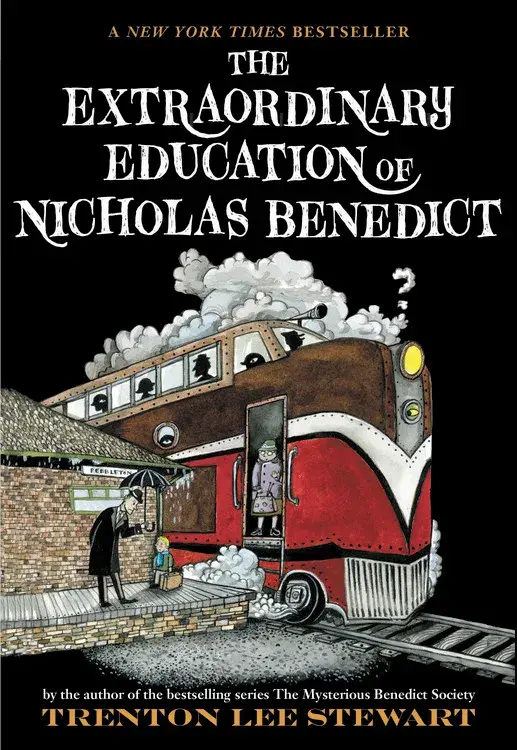
Carley: Oh good, I'm glad to hear it. Moving to your 2012 book The Extraordinary Education of Nicholas Benedict, you inserted some fun tidbits and callbacks for readers familiar with the MBS (like the origin of Mr. Benedict’s green plaid usage) and even created some new material that would eventually play a role in Riddle of Ages (e.g., the character Violet Hopefield). Did you have fun creating this book? How did you feel about getting into the mindset of a young Mr. Benedict?
Trenton: I had a blast creating this book! I’d thought I was done writing about the MBS characters, but
eventually a letter from one of my readers got me thinking seriously about young Mr. Benedict.
How had it not occurred to me that it would be delightful to write about a genius child with
narcolepsy who will eventually grow up to bring together a group of brilliant talents to save the
world? What led him to become not just a genius but the benevolent and magnetic person who
can recruit such an array of other geniuses to his cause? It was great fun to explore that story.
And now, a few rapid-fire questions:
Carley: What sparked your interest in becoming a writer? Was it a long-time aspiration, or something that happened later in life?
Trenton: I grew up in a family of storytellers. We were always making things up for our amusement. I
started writing silly poems and adventure stories at an early age, and by the time I headed to
college, I knew I wanted to be a writer.
Carley: There are plenty of action-packed scenes in the MBS books that involve HIGH STAKES
(basically the end of the world as we know it) and NEAR-DEATH EXPERIENCES (especially
where the Ten Men are involved). Are these moments an exciting experience for you when you
write about them?
Trenton: At some point in the process, yes, because I’m trying to experience them from the reader’s
perspective. But it isn’t a perpetual state of excitement – by the time I’ve finished with a scene
I’ve spent hours working on it, trying to get the effect right, and most of the work requires
concentration and effort rather than a racing pulse.
Carley: The Waiting Room freaked me out when I read the book for the first time. In a good way. Kind of. Was there ever a moment while you were writing when somebody (an editor or
otherwise) told you something was too intense or scary for a children’s series?
Trenton: In the original draft of MBS, the Recruiters (who in later books are known as the Ten Men)
actually carried pistols. My brilliant editor, Megan Tingley, correctly and helpfully suggested

that in middle-grade books it was fine to create scary situations but important to keep that buffer of fantasy – in short, the guns were a little too real. The great thing about this was that her advice led me to invent the shock watches and, later, the Ten Men’s deadly office supplies. The dangers felt much more whimsical after that. As for the Waiting Room (sorry to have freaked you out!), I did a similar thing in the sense that there is nothing actually physically dangerous about it, even though it’s horrible. And most of the scary things in the books are leavened by humor; it’s why I made Mr. Curtain somewhat cartoonish. He’s supposed to be menacing, but you can also laugh at him. I do try to find that sort of balance when writing for young readers.
Carley: What’s a weird or surprising (or both!) idea that you had for any of the MBS books that you eventually had to scrap?
Trenton: In the first draft of The Extraordinary Education of Nicholas Benedict, I ended the story with
young Nicholas being visited by a kind of dream version of the four children from the MBS –
since naturally those geniuses, especially Constance with her special gifts, would eventually find
some ethereal way to time travel. I loved the scene. It made me cry. But my editors (very gently)
told me it didn’t work. I revised the scene, made my argument for why it was good, and they
(again very gently) told me it still didn’t work. And they were right. Finally I realized I just had
to get something out of my system – I was having a hard time saying goodbye. Then I wrote the
new ending, and that was that.
Finally I realized I just had to get something out of my system – I was having a hard time saying goodbye.
Carley: Who was the easiest/favorite character for you to write about? Contrariwise, who was the most challenging?
Trenton: That’s a very tough question to answer. I loved writing about all these characters, and I don’t
remember any of them being harder to write about than others. (I’m sure that’s not true, but it’s
been a while.) I do think I most enjoyed writing about the MBS kids, especially when they were
in full problem-solving mode. But the others were also plenty entertaining.
Carley: Would you consider yourself to be more like Mr. Benedict or Mr. Curtain?
Trenton: Like both of them, I’m often sleepy, but I hope I’m more like Mr. Benedict, who is generally

kind, and less like Mr. Curtain, who is generally narcissistic and domineering and, you know, evil.
Carley: If you’re able to share, what is your current writing project? Is it similar to what you’ve published so far, or something completely new?
Trenton: I’m working on a novel called Flyout, based on the true story of an owl named Flaco who escaped from the Central Park zoo and lived free for a year in New York City. Definitely something completely new.
Carley: What book are you currently reading?
Trenton: Probably because I’m thinking a lot about human-animal encounters these days, I’ve just started a novel called Whalefall, by Daniel Kraus, in which the 17-year-old scuba-diving protagonist
gets swallowed by a sperm whale and has to figure out how to survive. I’ll be taking careful
notes, in case this ever happens to me.
I have to ask a few questions about Kate and Milligan, because their endearing father-daughter relationship is possibly my favorite part of the series:
Carley: Oftentimes, fictional characters are inspired by real people or experiences. Where did you get the idea of Milligan from?
Trenton: Not from a real person, although I’m guilty of having told many children that Milligan was based upon my own experience as a secret agent. (In my defense, I always eventually tell the truth.)
And I honestly don’t know where the idea came from!

Carley: So his origin is as mysterious to you as it is to the readers! Reynie, Sticky and Constance Contraire all seem to have a clever meaning or story behind their names. Is the same true for Kate?
Trenton: Kate’s last name, Wetherall, is meant to reflect her irrepressible, optimistic personality. She
“weathers all” things – meaning she endures all things. She got her first name simply because I
always liked the name Kate.
Carley: What’s Milligan’s original name?
Trenton: It’s still a mystery, even to me.
Carley: Do you know anything about Kate’s mother that didn’t make it into the books?
Trenton: I don’t. I assume she was a lovely person, and probably someone with a great deal of humor and tolerance.
Carley: One more - Milligan and Kate seem to have a strong mutual belief in each other’s capabilities and love one other fiercely. It sets the bar high for what I would hope for from a father. As their creator, where did this sweet relationship come from? Was it something you were lucky enough to experience, or just something you wanted to write into existence?
Trenton: I am definitely lucky. I always felt loved, supported, and believed in by my parents. And nothing moves me more than acts of love and kindness and sacrifice. So I suppose it was natural for me to want to create that dynamic for Kate and Milligan.
Carley: Finally, what is the question you always wish an interviewer would ask you, but never has?
Trenton:
Q: When your mother was a very young woman, did she ride bulls and bucking broncos in
rodeos?
A: Why, yes. Yes, she did.
Carley: Well, after that last response I have many more questions to ask, but for now I'll just have to say THANK YOU SO MUCH for taking the time to respond to my questions. It’s honestly a dream come true to be able to connect with the author of such a special series of books, and I hope you realize how sincerely I appreciate your work and how inspiring it’s been for me as an amateur writer.
Trenton: You’re very kind to say so, Carley! Thanks so much for your thoughtful questions. It’s been a
pleasure.

Visit Trenton Lee Stewart’s website to learn more about his characters, send a letter to Trenton , and stay updated with his latest literary news!
Writers Unite!


Comments